AI, Productivity, and “Infinite Intelligence” – Conversation with Chris Berg and John Humphreys

On Thursday evening, I joined John Humphreys of the Australian Taxpayers’ Alliance and Professor Chris Berg of RMIT University for an ATA livestream discussion on productivity (see Productivity ideas with Chris Berg). One of the most interesting parts of the conversation was on artificial intelligence (AI), which I’ve repurposed for my latest Economics Explored podcast episode.

Chris argues that AI could be the greatest productivity-enhancing technology since the Industrial Revolution. He noted studies showing that white-collar workers using tools like ChatGPT can already achieve productivity gains of 17–45%. If that holds true at scale, it would be transformational for economies like Australia’s, where sluggish productivity growth has become a major concern.

Thankfully, the Albanese Government has so far resisted pressure—particularly from unions and lobby groups—to introduce heavy AI regulation. Instead, it has adopted a wait-and-see approach, unlike Europe, where regulation is already slowing the rollout of new AI tools. Chris welcomed this hands-off stance, seeing it as giving Australia a chance to capture the benefits of AI adoption more quickly.

One of the more provocative points from Chris was his description of AI as providing “effectively infinite intelligence.” I challenged this idea, suggesting that while AI can synthesise vast amounts of existing knowledge, true intelligence involves solving new problems. Nonetheless, I share his view that AI represents an extraordinary advance.

We also discussed who wins and who loses in an AI-driven economy. Contrary to the usual automation story, Chris argued that it may be highly educated professionals who face more disruption than low-skilled workers, since AI excels at writing, analysis, and other cognitive tasks. At the same time, concerns remain about those unable to effectively use the technology being left behind.

Beyond work, AI raises broader social and ethical questions. We talked about AI companions, therapeutic uses (such as support for people on the autism spectrum), and risks of parasocial relationships or loneliness. The potential benefits are real, but so are the challenges.

Finally, one of the more imaginative suggestions was that low-skilled work in developed economies could in future be done by humanoid robots remotely operated from overseas. This would create a new twist on globalisation and migration policy—an idea worth thinking through further.

Overall, it was a fascinating conversation, with plenty of optimism from Chris about AI’s productivity potential, tempered by my own caution about the risks and unknowns.

If you’d like to watch the whole conversation with Chris, you can check it out on the ATA YouTube channel. In addition to discussing AI, we also discuss the Economic Reform Roundtable.

Please feel free to comment below. Alternatively, you can email comments, questions, suggestions, or hot tips to contact@queenslandeconomywatch.com. 

Posted in Uncategorized | Tagged , , , , | Leave a comment

Borrowing to Pay Wages

I caught up with Steve Austin on 612 ABC Brisbane this morning to discuss Sir Leo Hielscher’s sterling record as Queensland Under Treasurer in the seventies and eighties and to compare our state’s previous stellar financial performance with the mess we’re in today. You can listen to our conversation via the player below.

Among other things, Steve and I discussed the significant challenge the Crisafulli Government faces in dealing with the current teachers’ pay dispute: it is already borrowing to pay wages. Its revenue can’t even cover its recurrent, operating expenses, let alone generate an operating surplus that can contribute to paying for new public works (Figure 1).

Figure 1. Queensland General Government budget estimates

The operating deficit ($8.6 billion this financial year) needs to be corrected as fast as possible. The Government doesn’t want to be compared to the Newman Government, which suffered politically as a result of its significant public service cuts, but an operating deficit is unsustainable. It is akin to buying your groceries on your credit card and not paying down the balance every month, but letting the balance grow and grow. Eventually, the household needs to make hard choices.

Even with its relatively low forecast growth of expenses over the forward estimates, the government still can’t reach an operating surplus in the final forward estimates year of 2028-29. It will run a $1.1 billion deficit.

At a minimum, I would reverse the 50-cent fare policy, which Crisafulli inherited from the previous government, which was unfunded and only added to the operating deficit. The government also needs to undertake a thorough review of its spending, and risk a comparison to the Newman government, or it will have to increase taxes. That’s an option, particularly given that Queensland still has lower taxes than the national average. Still, I wouldn’t support higher taxes, as I’d prefer the adjustment on the spending side of the budget, given the adverse economic impacts of taxation. Low state taxes provide Queensland with a competitive advantage as a destination for investment and talent.

Over the next few years, the costs of abandoning Sir Leo’s fiscal lessons (the so-called ‘trilogy’ I discussed with Steve) will become more apparent. Interest expenses will more than double to over $7 billion, diverting money from health and education. At the same time as the interest bill rises, we will need to fund the Olympics. The Government will try to avoid the immediate budget impacts of the Games by entering into Public-Private Partnerships (PPPs). Still, it won’t be able to prevent significant future costs via ongoing subsidies to facilities that will likely be uneconomic without government support. Hard choices will have to be made by the decade’s end.

Please feel free to comment below. Alternatively, you can email comments, questions, suggestions, or hot tips to contact@queenslandeconomywatch.com. 

Posted in Budget | Tagged , , , | 1 Comment

Interest Rates, Australia’s 3 Biggest Challenges, Global Fertility Crash, & the Tobin Tax Debate w/ John Humphreys, Australian Taxpayers’ Alliance

The RBA will occasionally make mistakes, but abolishing RBA independence, as some commentators have suggested after this week’s surprising cash rate decision, would be a bad idea. I defended central bank independence in my latest Australian Taxpayers’ Alliance live stream with John Humphreys on Thursday night, citing the historical example of President Nixon pressuring Fed Chairman Arthur Burns to stimulate the US economy, which was already experiencing inflationary pressures (see How Richard Nixon Pressured Arthur Burns: Evidence from the Nixon Tapes). Having grown up in an era of high inflation, and wondering why the price of a sausage roll increased so much at the school tuckshop each year, I appreciate the generally low inflation we’ve experienced since central bank independence and inflation targeting were introduced in the 1990s.

John agrees we don’t want to sacrifice central bank independence but suggests we should consider a radical alternative: ending the government and central bank’s monopoly on the currency and fully embracing the concept of competing currencies. This would require abolishing the taxation of capital gains on alternative currencies, such as Bitcoin and other cryptocurrencies, which is currently in place. It’s a fascinating idea, and I’d encourage you to watch this clip from our livestream on RBA independence and competing currencies:

In our live stream, we also discussed James Tobin’s proposed tax on short-term international financial transactions (i.e. the Tobin tax), John’s concerns over low fertility rates and eventual global population decline (later this century), and our three biggest concerns regarding the Australian economy. Among others, we discuss stagnant productivity, the high cost of the energy transition, and unaffordable housing. You can listen to the whole conversation on my Economics Explored podcast:

Please feel free to comment below. Alternatively, you can email comments, questions, suggestions, or hot tips to contact@queenslandeconomywatch.com. 

Posted in Macroeconomy | Tagged , , , , , , , | 1 Comment

Australia’s Productivity Problem: Can It Be Fixed? w/ John Humphreys, Australian Taxpayers’ Alliance

In our latest Australian Taxpayers’ Alliance (ATA) livestream, ATA Chief Economist John Humphreys and I dissect the causes behind Australia’s productivity slump (Figure 1), analysing recent GDP data and the impacts of labour market policies, regulatory constraints, the high cost of energy, and ‘capital shallowing’. A big part of the story is no doubt the rapid expansion of the government and social services sectors, including the NDIS, we’ve seen in recent years, along with an immigration surge that has seen much job creation in low-paying service sector jobs (e.g. Uber Eats delivery drivers). 

In our wide-ranging conversation, John and I debate whether tax cuts should precede spending cuts, and we question the effectiveness of government intervention (i.e. ‘picking winners’) in driving innovation. Alas, the interventionist “Future Made in Australia” agenda appears to be the preferred approach of the current federal government. 

Furthermore, the Government has ruled out considering IR changes at its upcoming productivity roundtable. This is unfortunate because IR regulations inhibit the adoption of flexible and productivity-enhancing work practices. A couple of decades ago, but in still relevant research, my teammates in Treasury’s Macroeconomic Policy Division identified Australia’s IR regulations as a significant contributor to our productivity gap with the US (see Jyoti Rahman’s paper Comparing Australian and United States Productivity). 

My favourite part of the conversation is around 45-50 minutes into it, where John laments that much of the tax reform discussion isn’t about lowering taxes, but instead raising revenue in a more efficient way to pay for runaway public spending:

“Jim Chalmers was saying, Well, look, we’re trying to change the super tax…people are blocking me, so maybe they don’t believe in tax reform. And my jaw hit the floor. So, Jim Chalmers’ vision of tax reform is to introduce a new tax…I mean the opposite of that. I mean, we cut taxes. So that’s what worries me, that’s their vision. And the other, the standard thing, coming out of the Grattan Institute approach is we need tax reform because we have all of this runaway spending, and we need to pay for it somehow.”

John and I aim to make this a regular weekly livestream, so please tune in next Thursday at 7.30. You can watch our conversation on productivity via the YouTube player below or listen to the audio version via the embedded player.

These are personal views and shouldn’t be attributed to any organisation with which I have an association. Please feel free to comment below. Alternatively, you can email comments, questions, suggestions, or hot tips to contact@queenslandeconomywatch.com. 
Posted in Macroeconomy, Productivity | Tagged , | Leave a comment

Big Budget Challenge for New Qld Treasurer

Today’s Courier-Mail article reporting that Townsville University Hospital can’t afford to fix its elevators reminded me of something a former state Under-Treasurer told me when I researched my 2018 book Beautiful One Day, Broke the Next. He told me governments like spending money on brand new infrastructure, but they often don’t allow sufficiently for ongoing maintenance and refurbishment. 

I’m sure the resources could readily be found if the state budget were in better shape, but ever since state debt started growing rapidly from the late 2000s, state governments have had to divert more money to pay interest to bondholders. They can’t spend this money on frontline services like health and education. In the mid-2000s, just before the fiscal recklessness started, general government interest expenses only absorbed 0.5-0.6% of revenue. Now, at around $2.4 billion annually, they absorb 2.7% of revenues and the latest budget update projects that by 2027-28 they are estimated to be $6.6 billion or 6.9% of revenue (Figure 1). The increasing debt service burden is a significant reason state governments now struggle to fund essential services. Previous governments borrowed large sums of money to finance new infrastructure that couldn’t pay for itself and instead burdened the budget with debt service and ongoing maintenance and refurbishment expenses. 

The new Queensland Government faces a mighty challenge in budget management. It must address service delivery failures while finding additional money to respond to natural disasters and deliver the Olympics, keeping the debt under control and avoiding a credit rating downgrade. 

I look forward to the new Queensland Treasurer’s thoughts on the state economic and fiscal outlook when he addresses a business lunch the Economic Society of Australia (QLD) is hosting at the Sofitel on Wednesday, 9 April. I am the President of the Society, but the views expressed in this post are my views and should not be attributed to the Society. You can learn more about the lunch and book tickets via this link:

Business lunch with The Honourable David Janetzki MP, Treasurer, Minister for Energy and Minister for Home Ownership 

Please feel free to comment below. Alternatively, you can email comments, questions, suggestions, or hot tips to contact@queenslandeconomywatch.com. Also, please check out my Economics Explored podcast, which has a new episode each week.
Posted in Budget | Tagged , , | Leave a comment

Federal Budget, the Olympics, & Trump’s Tariffs Chat with Damian Coory & Dan Petrie

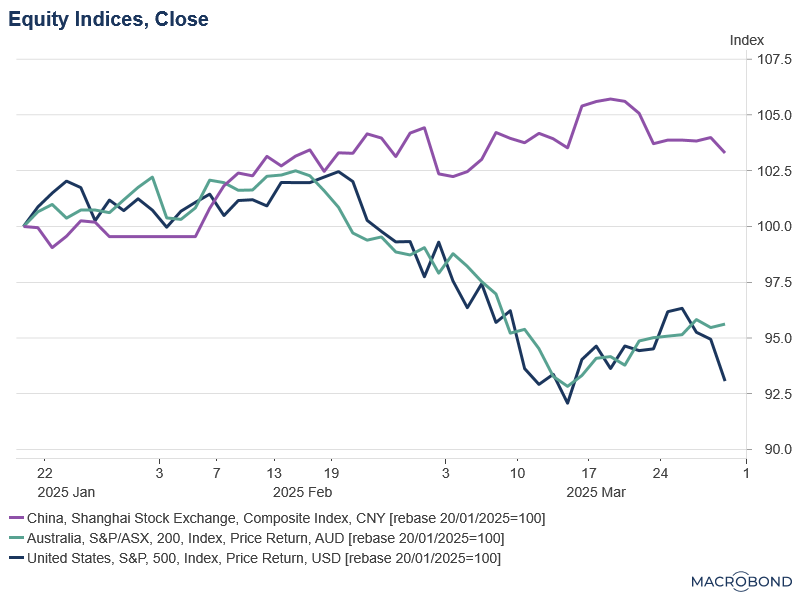
Is there a brilliant ‘Art of the Deal’ strategy behind Trump’s tariff policy? It has been a big failure for the US so far, as attested to by the 7% fall in the US share market since inauguration day (see the chart below) and a 12% fall in consumer confidence from January to March, according to the Conference Board. The US has inflicted more harm on itself than its trading partners.

Theoretically, there is the possibility a large country like the US, as opposed to a small country like Australia, can impose an ‘optimal tariff’, as Nicholas Gruen and I explain in an article published in Crikey: Why Trump’s tariffs are better than you think — and much worse. We note:

“When large countries trade, they move prices. That means foreigners do effectively pay some of their tariffs.”

A member of Keynes’ Cambridge Circus,  Richard Kahn, wrote the best and most lucid paper on the so-called optimal tariff, Tariffs and the Terms of Trade, published in 1947. Based on Kahn’s optimal tariff formula and plausible values for the parameters, an optimal tariff for the US could be around 20%. However, this calculation is based on a theoretical model without retaliatory tariffs or macroeconomic implications. The benefits of the terms of trade improvement can be quickly outweighed by the costs of retaliation and a global trade war, as well as the fact that tariffs increase the tax burden on American consumers and businesses and will have adverse macroeconomic impacts. Nicholas and I aren’t defending the Trump tariffs. Indeed, we’re supporters of free trade, as you would expect economists to be, but we are pointing out that the terms of trade impact must be considered when assessing the tariffs. Based on the fall in the S&P 500, American investors have judged that the adverse macroeconomic effects of tariffs will outweigh any possible terms-of-trade benefits. 

Earlier this week, I spoke about Trump’s tariffs, the federal budget, and the Olympics with fellow Queenslanders Damian Coory and Dan Petrie on Damian’s The Other Side Unplugged show. You can watch the interview here:

I’ve included the time stamps below so you can jump to my remarks on the latest federal budget, the Olympics, and Trump’s tariffs, if you’re interested:

  • Federal Budget Overview and Critique (0:00)
  • Jim Chalmers’ Values-Based Capitalism (5:38)
  • Structural Deficits and Bracket Creep (10:56)
  • Government Spending and Debt Concerns (13:55)
  • Olympic Games Plan for Brisbane (30:52)
  • Trump’s Tariffs and Their Economic Impact (41:15)
  • Alternatives to Promote Economic Growth (54:39)
  • Final Thoughts and Future Directions (55:57)

Please feel free to comment below. Alternatively, you can email comments, questions, suggestions, or hot tips to contact@queenslandeconomywatch.com. Also, please check out my Economics Explored podcast, which has a new episode each week.
Posted in Brisbane, Productivity, Trade | Tagged , , | Leave a comment

$1k each power bill subsidy is an irresponsible & desperate vote-buying exercise

It’s not uncommon to find energy subsidies being criticized in IMF reviews of emerging economies. They’re often a policy favoured by irresponsible autocrats, as we’ve witnessed in various economic basket cases like Venezuela under Hugo Chavez. It seems the Queensland Government is drawing inspiration from some irresponsible emerging economies. The Courier-Mail reports that the Queensland government plans to distribute $1,000 of power bill rebates to households over the second half of 2024, at a staggering total cost of $2.5 billion. This move is nothing short of a grossly irresponsible and desperate vote-buying exercise. The government’s most recent forecast (in December 2023) of its operating surplus for 2024-25 was a mere $122 million, which will be completely swamped by the $2.5 billion (i.e. $2,500 million) cost of the subsidies. 

They are not borrowing to build, but borrowing to pay for short-term expenses. Consider this: it’s akin to paying for your groceries on your credit card and not settling the balance within the 30-55-day interest-free period. We, the taxpayers, will bear the brunt of this cash splash for years, if not decades, to come. The ongoing interest bill on the additional $2.5 billion of debt the Government will incur, at 4-5% government borrowing rates, translates to an ongoing annual cost to the budget of $100-125 million. This financial burden will persist beyond the next financial year, inevitably reducing funds for crucial sectors like health, education, and policing in the long term.

It’s clear that the government simply cannot afford this measure. Instead, the government should do all it can to prevent the huge blowout in gross government debt to $188 billion, which it had previously warned about. 

The government may have some clever way to pay for this measure that avoids a large operating deficit next year that I’m unaware of–for instance, if it has collected more coal royalties than expected, it could make an equity injection into Energy Queensland this financial year by 30 June. Still, it can’t avoid the fact that this ultimately means more debt than otherwise on the balance sheet. 

This is not only economically and fiscally irresponsible but also environmentally irresponsible. If the government is targeting a 75% by 2035 reduction in greenhouse gas emissions, shouldn’t it be sending households a signal that they should conserve electricity? Instead, it’s subsidising electricity bills. 

This is bad policy from a desperate government doing all it can to hold onto seats at the next election.

Please feel free to comment below. Alternatively, you can email comments, questions, suggestions, or hot tips to contact@queenslandeconomywatch.com. Also, please check out my Economics Explored podcast, which has a new episode each week.
Posted in Budget | Leave a comment

Huge upward revision in state debt – what’s going on?

We’re getting close to the point where we must respect the adage “no one ever kicks a dead dog” about the current Queensland state government. But it’s left itself open to criticism about its latest huge upward revision to state debt, well past what anyone would have expected.

You have to wonder how the rating agencies will interpret this. Will they start thinking about a credit rating downgrade? Also, you have to wonder how long the government has known about the debt blowout and whether it should have revealed it earlier. The figures that have been released to the Courier-Mail suggest big changes to the mid-year-update figures the government published four months ago. It can’t all be due to what is expected to happen in 2027-28, the new year which will be reported on in the coming budget.

The Courier-Mail reports gross government debt will reach $188 billion by 30 June 2028. General government debt will reach $128 billion, and net debt will reach $73 billion (compared with only $15 billion in the general government sector in 2023-24).

In the December mid-year budget update, the government projected total debt of $149 billion by 30 June 2027. At the previous rate of debt increase, you might have expected them to end up with around $160-165 billion of debt by mid-2028, but now they’re revealing debt could be $188 billion. That’s a big acceleration in the rate of debt accumulation. What is going on?

From what I can tell, it’s a combination of:

  • huge vote-buying cost-of-living relief (e.g. electricity bill rebates) the government will offer in the upcoming budget;
  • infrastructure cost blowouts; and
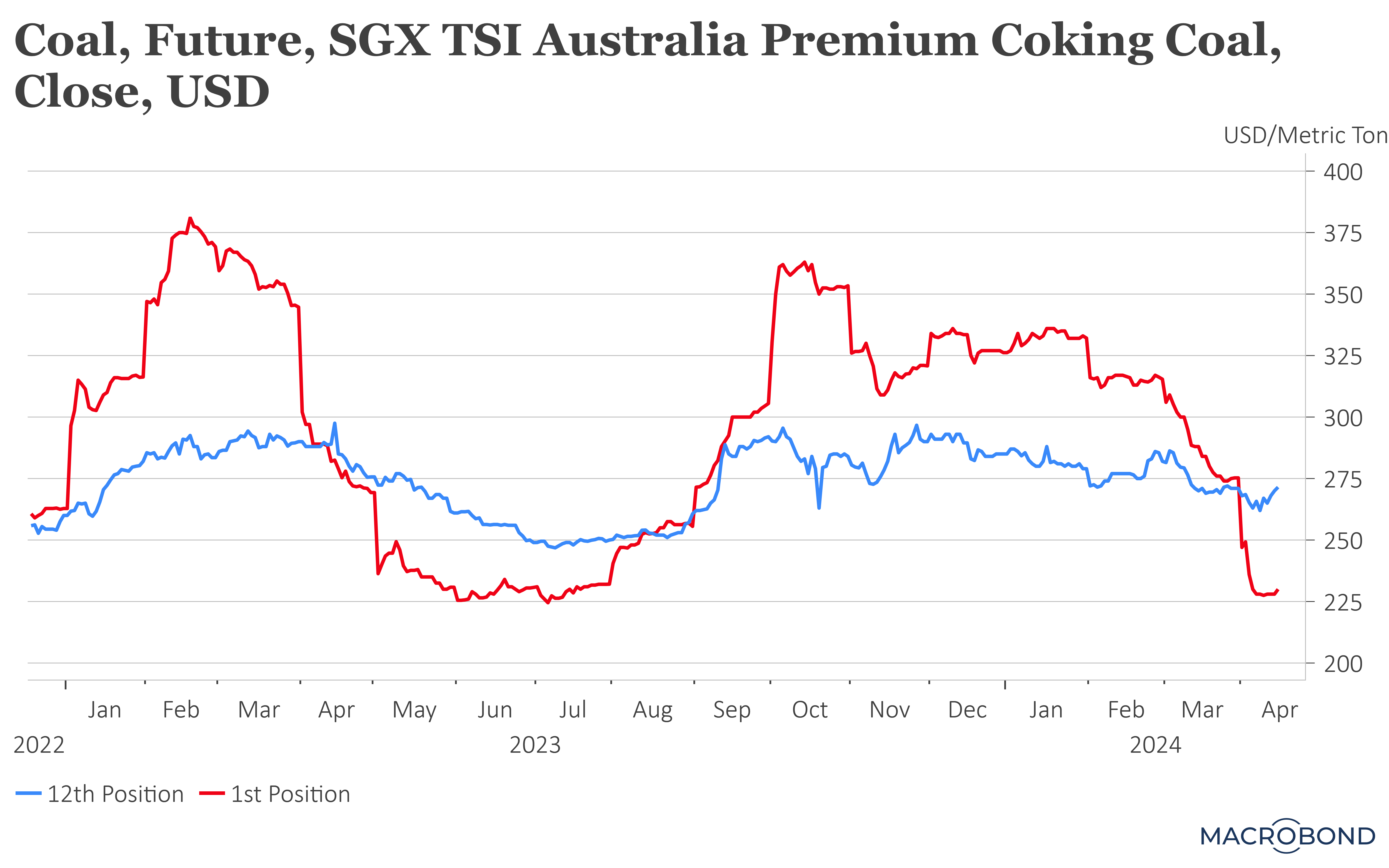
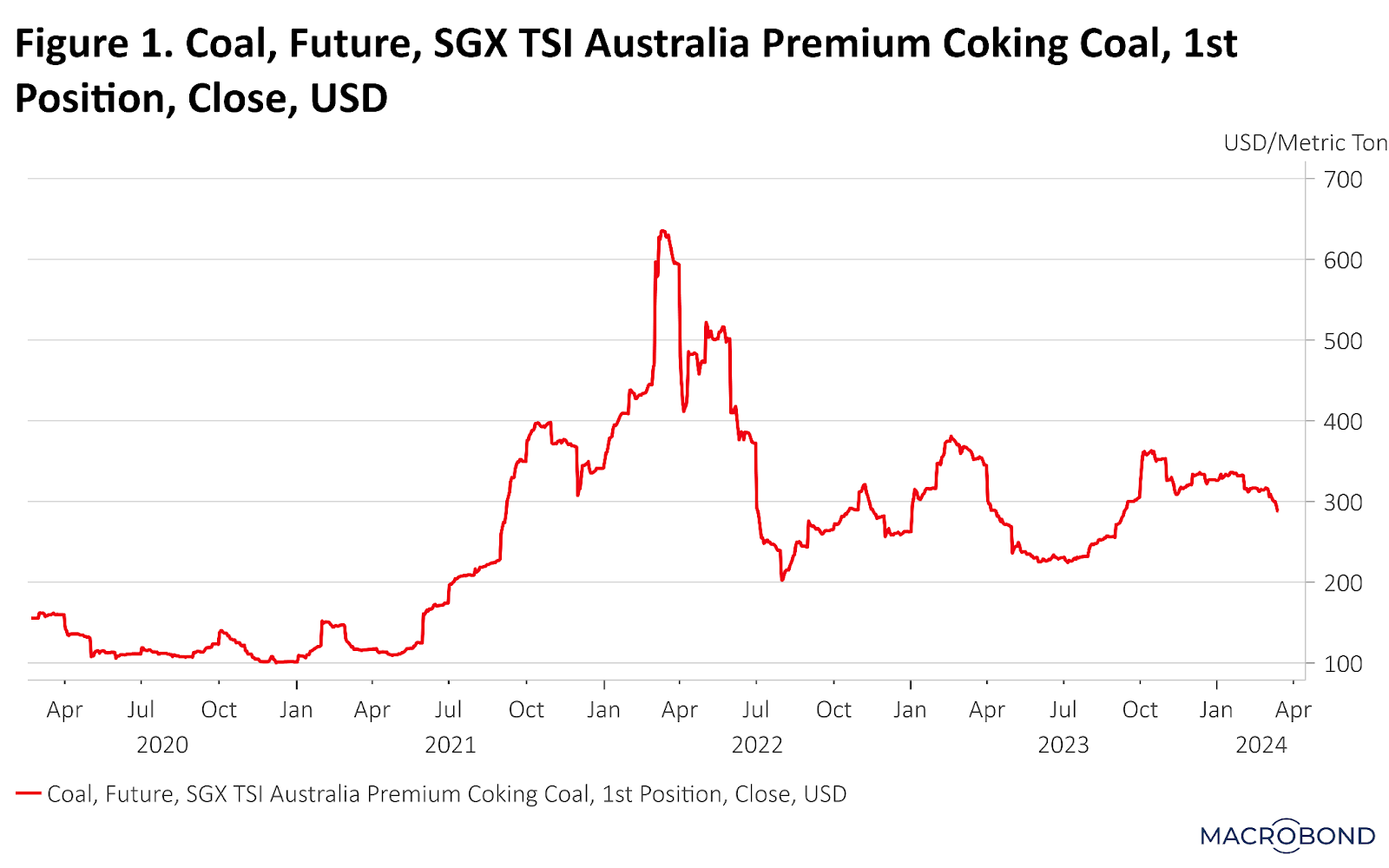
  • the recent fall in coal prices (see chart below), which means the revenue upside I was hoping for in my previous post probably won’t occur – although I’d note the 12-month ahead futures price (12th position in the chart) has been much more stable than the price for contracts settling in the current month (1st position in the chart).

I accept state governments can get away with some debt to “borrow to build”, so to speak, but I will be very concerned if part of the debt surprise is borrowing for cost-of-living relief that gives us a net operating deficit. Borrowing to cover recurrent or operating expenses violates the so-called Golden Rule of Public Finance. You can read all about that, as well as about how everything started to go wrong during the Bligh government, in my 2018 book Beautiful One Day, Broke the Next.

Please feel free to comment below. Alternatively, you can email comments, questions, suggestions, or hot tips to contact@queenslandeconomywatch.com. Also, please check out my Economics Explored podcast, which has a new episode each week.
Posted in Budget | 1 Comment

Fossil fuels to figure in Qld’s future for decades to come

Despite the Queensland Government promoting the so-called Clean Economy, our state Treasury is still highly dependent on coal royalties, and the prosperity of our regional economies is highly correlated with coal mining. Coal prices remain at high levels and may deliver Treasurer Cameron Dick some additional budget billions if they don’t fall substantially by the end of the financial year (Figure 1).

On my calculations, coking coal prices have averaged around 300 USD/tonne this financial year to date, compared with the current state budget assumption of 241 USD/tonne over 2023-24. From the 2023-24 State Budget (Paper 2, p. 242), we know “A one per cent variation in the average price of export coal would lead to a change in royalty revenue of approximately $98 million.” If average coal prices remain around 25% above the assumed level for 2023-24, possibly too optimistic an assumption given the trajectory of the coal price, that would mean an additional $2.5 billion in coal royalties this financial year on top of the $9.2 billion already forecast. I will keep a close eye on this in the lead-up to the budget and provide further updates.

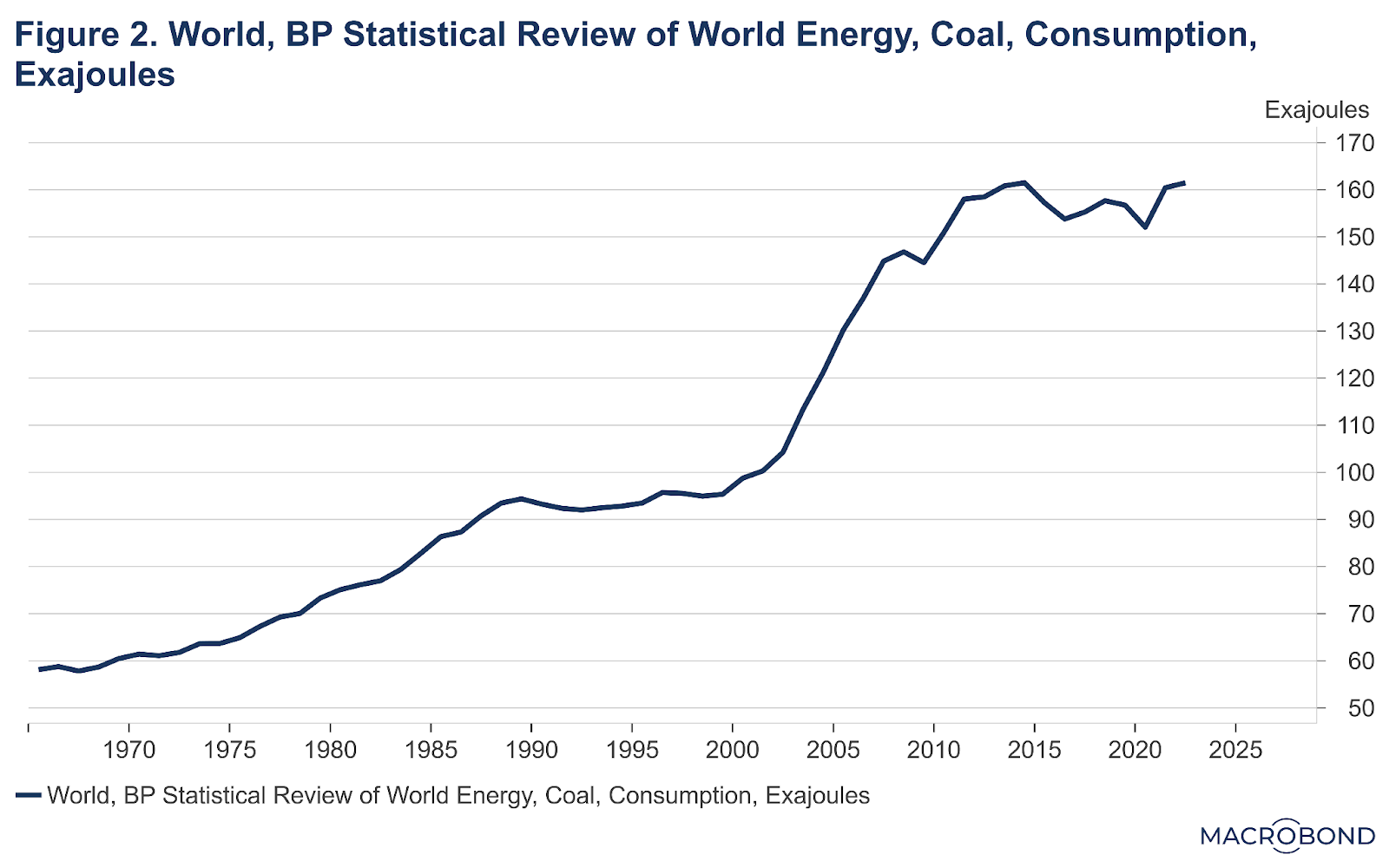
Of course, I need to acknowledge the broader context. There appears to be widespread support for decarbonisation in advanced economies, which would imply a very challenging adjustment for Queensland. However, coal (and gas) will likely remain important to the state economy for at least several decades. There are well-known facts about two-thirds to three-quarters of our coal exports being coking coal, essential for steel production for now, and how China and India keep building new coal-fired power plants. For example, according to Reuters, India is adding nearly 14 gigawatts of coal-fired capacity this year. Worldwide, coal consumption is 75% above what it was in 1992, the year of the Rio Earth Summit, which brought in the UN Framework Convention on Climate Change (Figure 2). Greta Thunberg was right that all the fine words of our leaders have amounted to nothing more than “Blah, Blah, Blah.” Consumption of coal is stabilising but is not yet plummeting as rapid decarbonisation advocates would like to see.

The other consideration is growing concerns that the transition to greener electricity will be rocky, with intermittent renewables making supply less reliable, for example. In my latest Economics Explored podcast interview, I spoke with Kansas City-based investment manager Ben Fraser of Aspen Funds, who is betting that the rocky energy transition will bolster demand for energy-dense, reliable fossil fuels. Ben argues:

“we’re at the early stages of an energy crisis that we haven’t seen in a long time. And it’s really going to be driven by a supply shortage of fossil fuels. As we’re making a transition into more green energy, renewable energy sources, that is really being driven by a political narrative that…at its worst is creating a huge gap of understanding of what it’s going to take to make this transition. And [we’re] really putting ourselves in a really bad position from a production and supply standpoint of fossil fuels over the next several decades that we believe is going to be pretty, pretty severe.” [at 14:55] 

“And so we really believe there’s a huge opportunity to get into fossil fuel production. So we’re investing a lot into these operating wells at really good prices.” [at 27:58]

This is not investment advice, but Ben’s thesis is very plausible. It’s probably safe to bet that the world will be reliant on Queensland’s coal for decades to come. And there are too many jobs at stake and too much money to be made, including for the state government, for it to shut down coal production in Queensland. 

This is not to deny we need to respond to climate change over the coming decades. But it probably won’t be by sharply cutting coal consumption anytime soon. Physicist Sabine Hossenfelder is probably right that, globally, we’ll have to undertake risky Climate Engineering as it will end up being the “cheapest way to get us out of this unfolding climate disaster”, as she puts it.


Please feel free to comment below. Alternatively, you can email comments, questions, suggestions, or hot tips to contact@queenslandeconomywatch.com. Also, please check out my Economics Explored podcast, which has a new episode each week.
Posted in Climate change, Mining | Tagged , , , , , | 2 Comments

How the Qld economy has changed in recent decades

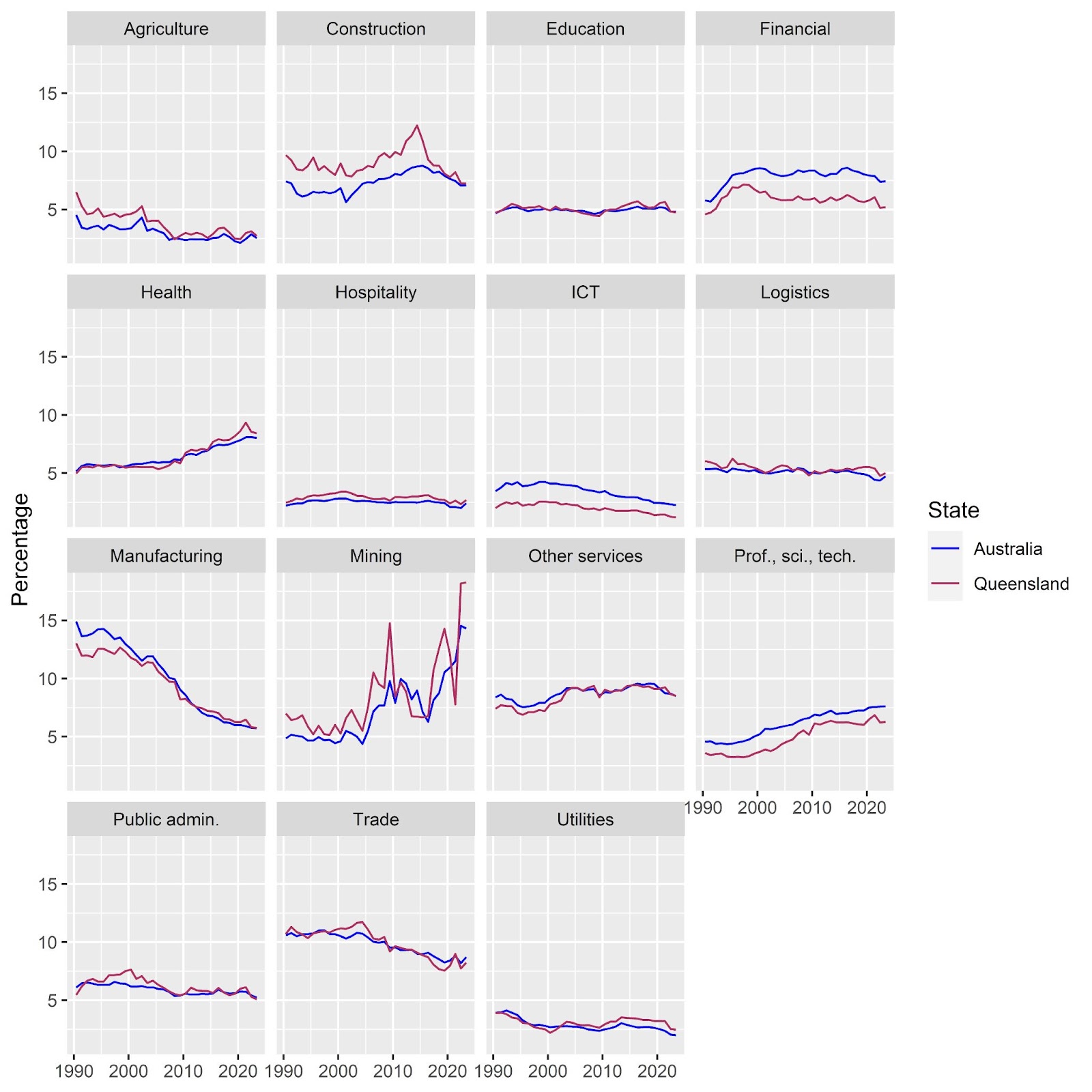
The state and national economies have experienced similar trends by industry since 2000. The big changes have been the 2-3x increase in the mining sector’s importance since China’s economic growth started significantly influencing the global economy in the early-2000s (Figure 1). Because of the massive growth in mining in WA, too, the nationwide mining share has surged as well as that of the mining states. Services sectors such as health and professional, scientific and technical services have also expanded strongly relative to other sectors. 

Figure 1. Shares of total industry gross value added by industry division, 1989-90 to 2022-23

Source: ABS State Accounts, 2022-23. Note: shares are calculated using the current price data for each financial year. 

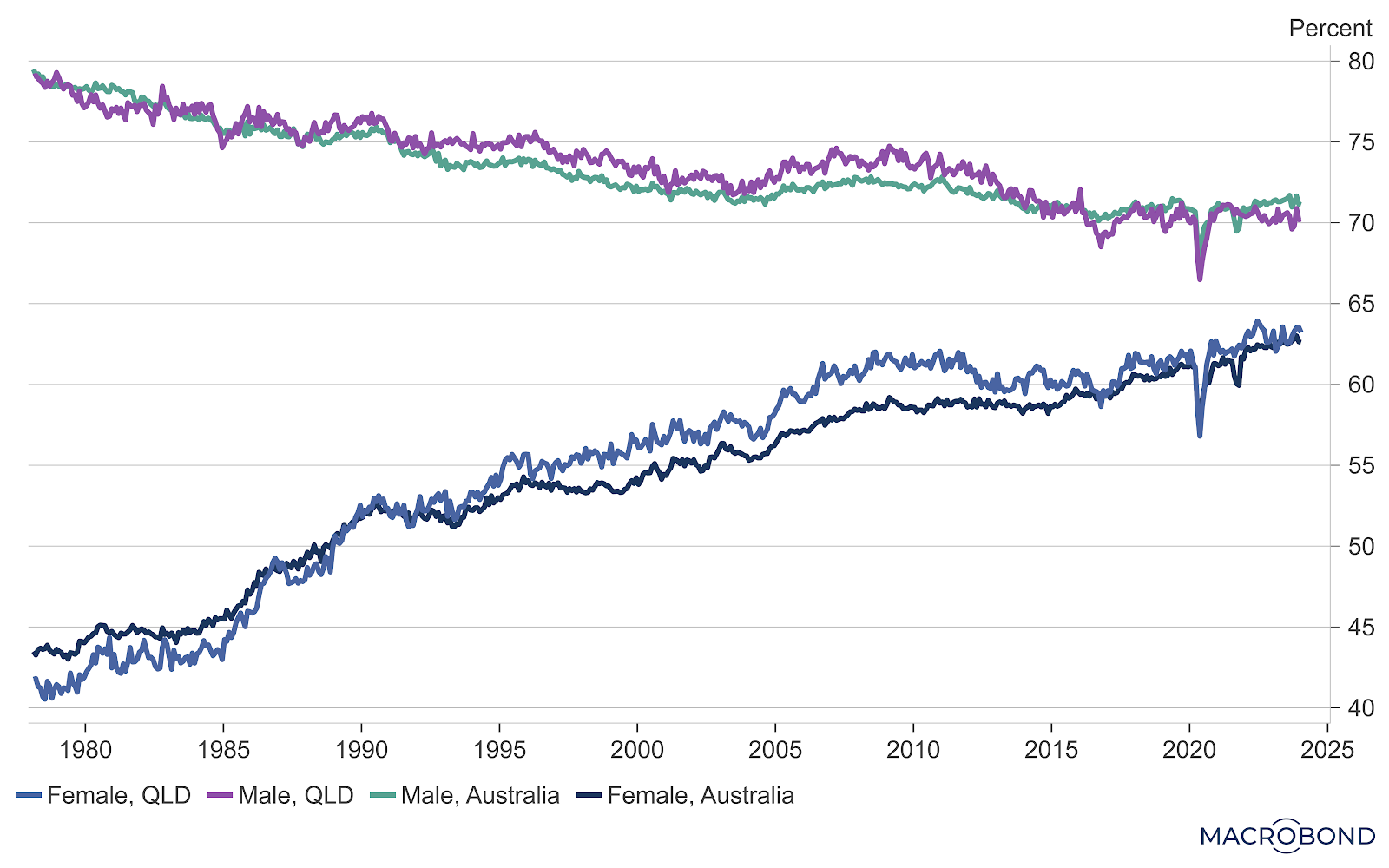
The expansion of services sectors has been assisted by an increase in the female workforce participation rate in recent decades, although the bulk of the increase was over the 1970s to 1990s. This trend has been offset partly by declining male participation (Figure 2). 

Figure 2. Labour force participation rates

Source: ABS Labour Force.

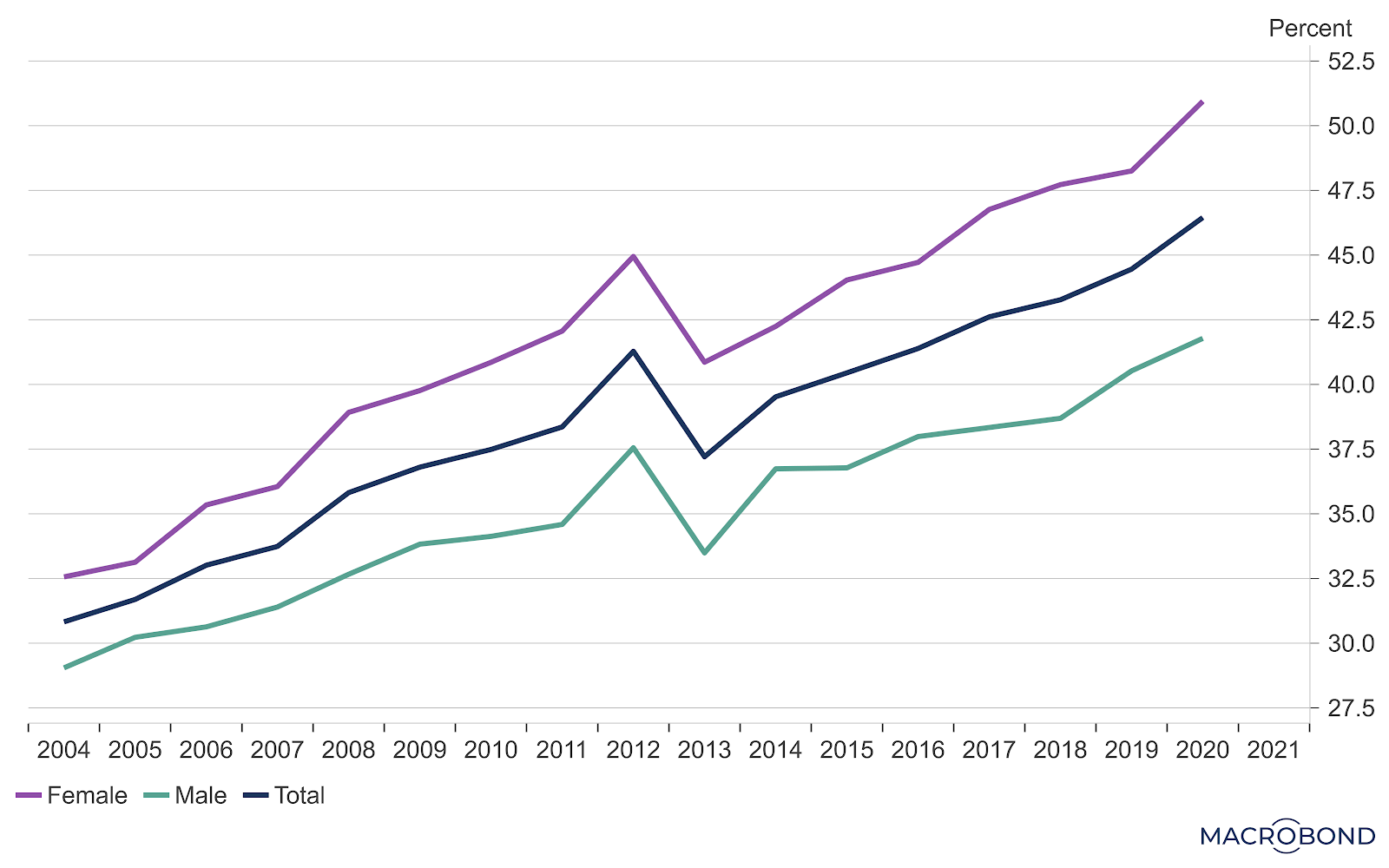
Also supporting the expansion of services sectors has been increasing levels of educational attainment (Figure 3). This has been a positive trend, but there are concerns over credentialism and people not using their tertiary education in their jobs. Also, given current skills shortages in construction, one wonders whether too many people have gotten university degrees rather than trade qualifications. 

Figure 3. Educational Attainment, Proportion of people 25+ who have at Least Completed Short-Cycle (at least 2 years) Tertiary, Australia

Source: World Bank, World Development Indicators.

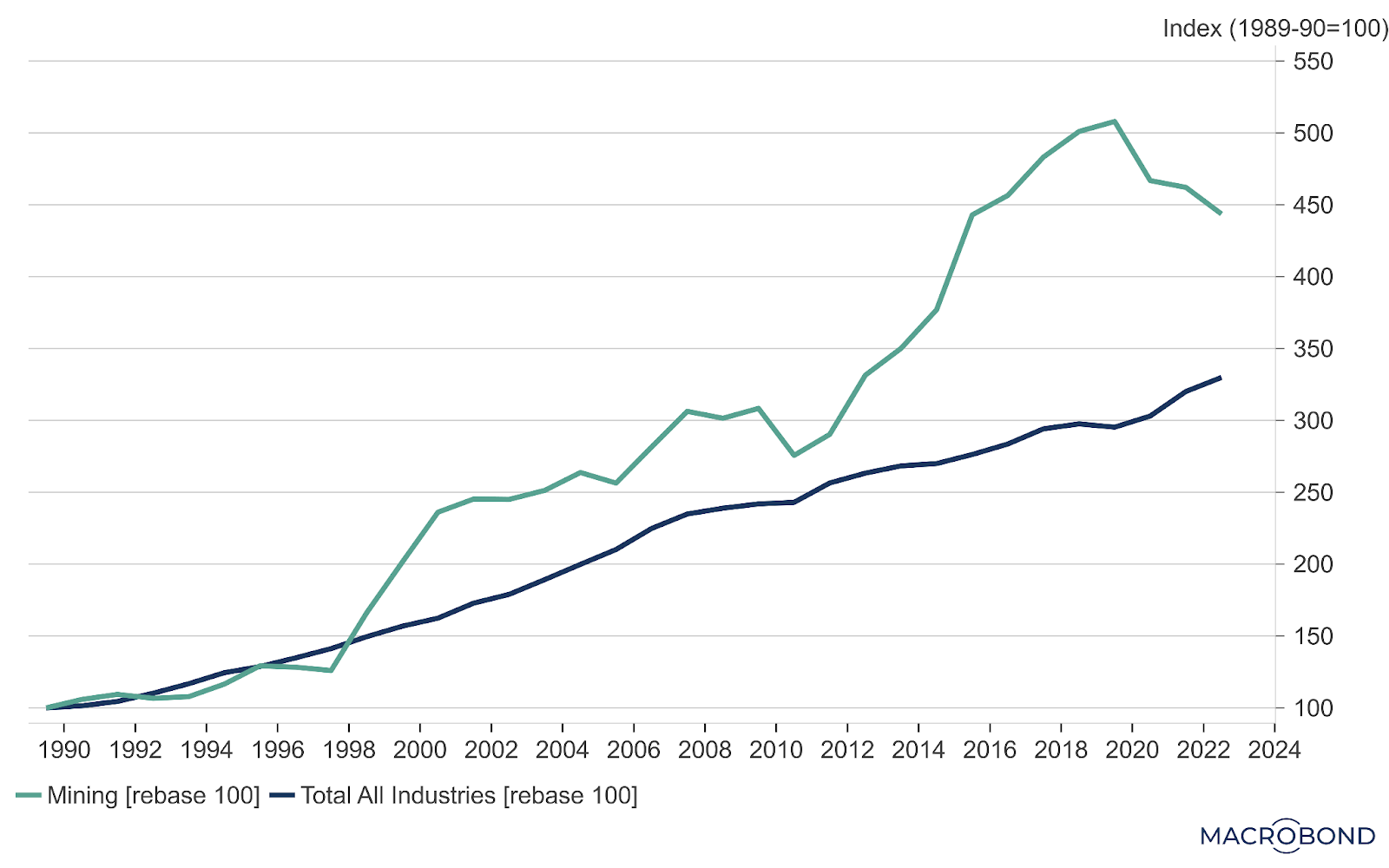
Regarding mining, compare the growth of mining in Queensland with all industries in Figure 4, which shows chain volume or real (inflation-corrected) value-added estimates. This confirms the surge in mining is both a price and volume story. We’ve expanded our production substantially in recent decades and taken advantage of higher commodity prices at times.

Figure 4. Industry value added in mining versus all industries, Queensland, chain volume measures

Source: ABS State Accounts, 2022-23.

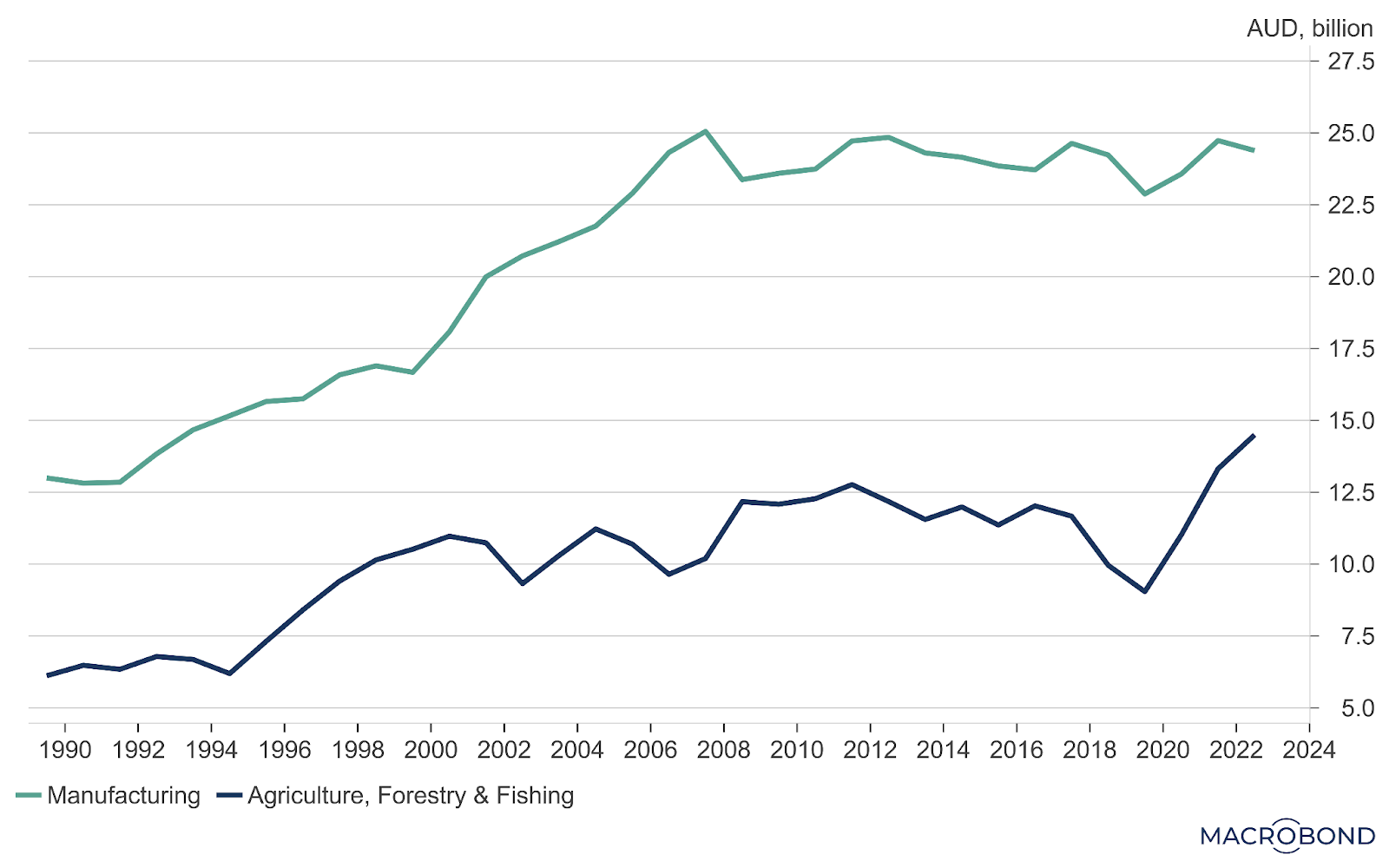
In contrast, Agriculture and manufacturing have declined in relative terms, and indeed manufacturing has flatlined in absolute terms since it peaked in the first decade of this century (Figure 5). Volatility in the agricultural sector makes it hard to discern the long-term trend, but arguably it is still positive. Part of the upward trend would be the shift to higher-value crops in many regions, such as macadamias replacing sugarcane on many fields in Bundaberg. 

Figure 5. Agriculture and manufacturing gross value added, chain volume (i.e. real) estimates

Source: ABS State Accounts, 2022-23.

Because of the disproportionate importance of mining in Queensland, it makes sense that some other sectors have contributions to the state economy lower than in the rest of Australia. All the shares have to add up to 100% after all. Financial services, ICT and professional, technical and scientific services have shares noticeably below those in the rest of Australia.

As I noted in the Queensland Future State report that I co-authored with Peter Faulkner for ANZ last year: 

“Historically, NSW and Victoria have been home to more corporate headquarters than Queensland and this has been reflected in proportionately more professional jobs based in southern states. ABS data on businesses by employment size and main state of operation show, at the end of the 2022 financial year, Queensland had 784 businesses with 200 or more employees, compared with 1,672 in NSW and 1,238 in Victoria. NSW had 2.1 times and Victoria had 1.6 times more large businesses than Queensland, even though they had only 1.5 and 1.2 times the population of Queensland, respectively.”

Luckily, we have a strong resources sector which helps compensate for any relative lack of vigour in other sectors. I’d like to see higher-valued services sectors increase their shares of the Queensland economy. Still, governments shouldn’t deliberately try to engineer that with activist industry policy. I think the best thing to do is to focus on improving our education system and aiming for as competitive a taxation system as possible. Thankfully, Queensland still has lower-than-average state taxation, but we lost our title as the lowest-taxing state during the Beattie years (see Julie Novak’s paper Queensland the low tax state). It would be good to aim for that title once again. 

To conclude, I have great optimism for Queensland in the future, but we can clearly do some things better, and there are short-term economic concerns, as I discussed in The Queensland Economy Post-Palaszczuk.

 Please feel free to comment below. Alternatively, you can email comments, questions, suggestions, or hot tips to contact@queenslandeconomywatch.com. Also, please check out my Economics Explored podcast, which has a new episode each week.
Posted in Budget, Macroeconomy, Tax | Tagged , , , , , | Leave a comment